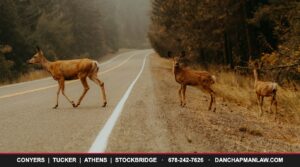
Oh, deer. If you drive anywhere in Georgia this time of year, you’ve probably had at least one close call with a deer leaping across the road. Fall is mating season (the “rut”), and deer are on the move. If a near miss turns into a deer collision in Georgia, a few smart steps can save you hassle with your car, your insurance, and your wallet.
Here’s what to do, who pays for what, and the times when someone else may be responsible.
Why Deer Collision Season Peaks in the Fall
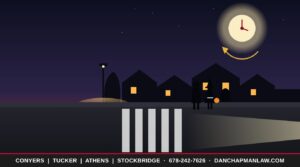
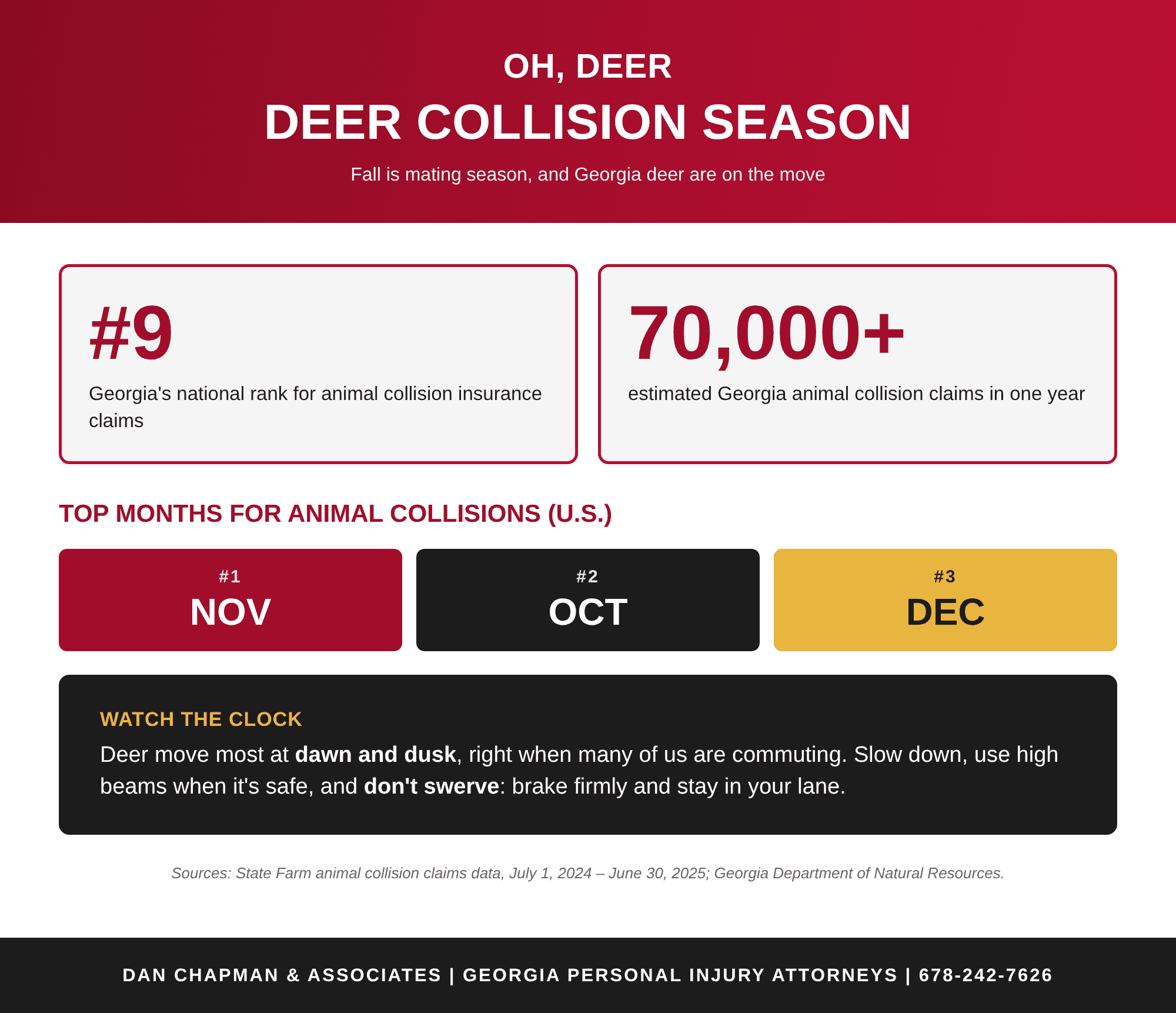
According to the Georgia Department of Natural Resources, deer are most active during the fall breeding season, roughly October through late December depending on where you live. They move most at dawn and dusk, which lines up with the morning and evening commute, especially now that clocks have fallen back.
Insurance data tells the same story. In State Farm’s most recent state-by-state report, Georgia ranked 9th in the nation for animal collision claims, with more than 70,000 estimated claims from July 2024 to June 2025. Nationally, November, October, and December were the top three months for these crashes.
How to Avoid a Deer Collision in Georgia
- Slow down at dawn and dusk, especially on rural roads, near wooded areas, and where you see deer crossing signs.
- Where there’s one, there’s more. Deer often travel in groups, so if one crosses, slow down and expect another.
- Use your high beams when there’s no oncoming traffic. They help you spot eyes shining along the shoulder.
- Don’t swerve. Georgia DNR’s advice is to brake firmly and stay in your lane. Swerving can send you off the road or into another car, which is usually far more dangerous than hitting the deer.
- Buckle up and put the phone down. A split second of attention makes a big difference.
Hit a Deer? Here’s What to Do Next
- Pull over safely and turn on your hazard lights. Check on everyone in the car.
- Stay away from the deer. An injured deer can kick and cause serious injuries. Don’t try to move it.
- Call police. Georgia law requires you to report a crash right away when there’s an injury or at least $500 in property damage (O.C.G.A. § 40-6-273), and a police report also helps with your insurance claim. Here’s how to get a car accident report in Georgia.
- Take photos of your car, the road, the deer, any skid marks, and anything else nearby.
- Get checked out. Even a low-speed deer collision can cause whiplash or other injuries that show up later.
- Call your insurance company and tell them exactly what happened, including whether another car was involved.
Who Pays After a Deer Collision in Georgia?
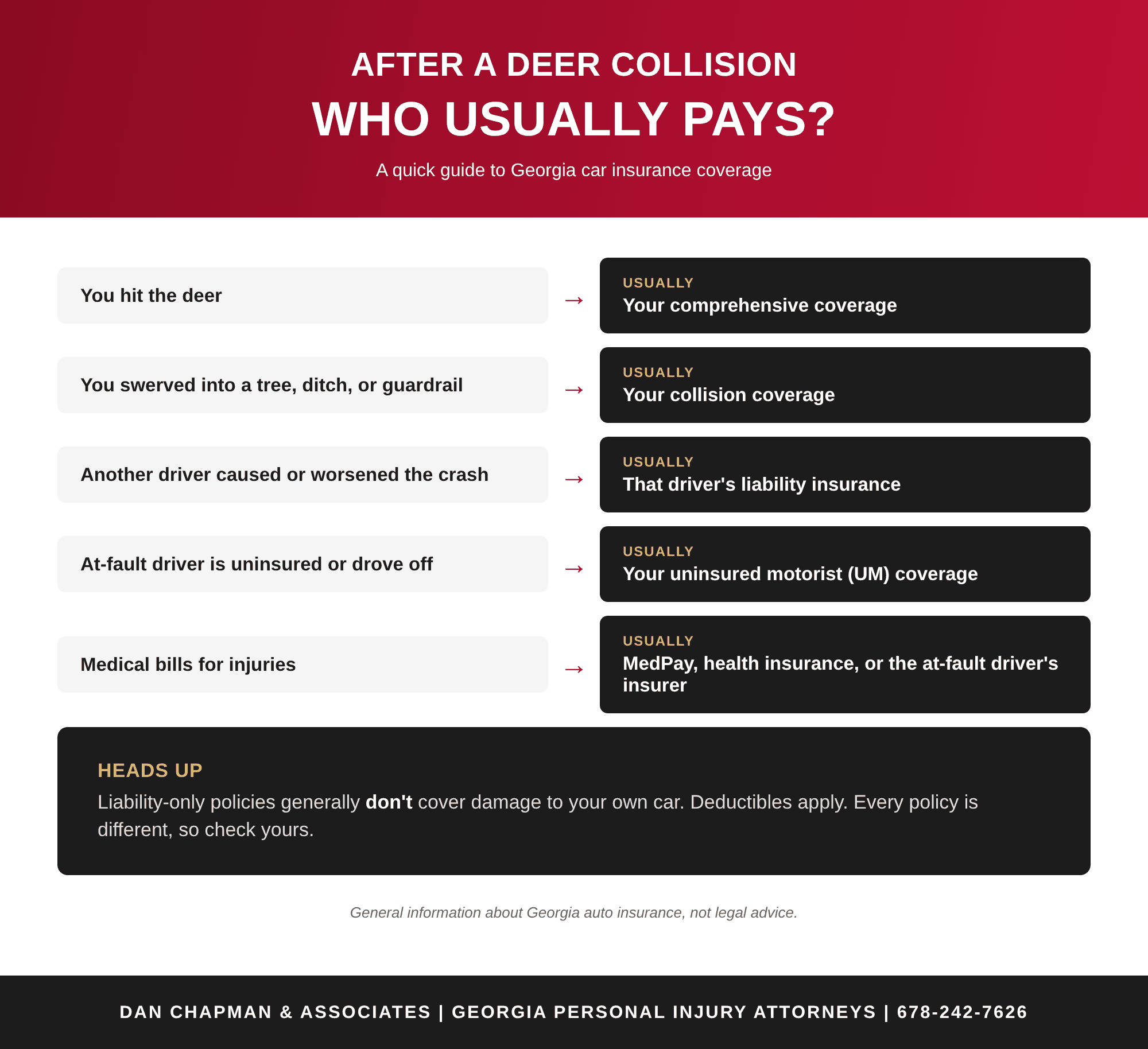
In most Georgia deer collision cases where it’s just you and the deer, your own insurance handles it. Which part of your policy pays depends on what happened:
- You hit the deer: This is usually covered under comprehensive coverage (sometimes called “other than collision”), minus your deductible.
- You swerved and hit a tree, guardrail, or ditch: This is usually treated as a collision claim, which may carry a different deductible.
- You only carry liability insurance: Unfortunately, liability-only policies generally won’t pay for damage to your own car.
- Injuries: Medical payments coverage (MedPay), if you have it, and your health insurance can help with medical bills. Read more about who pays medical bills after a car accident in Georgia.
If the damage is severe, your insurer may decide the car isn’t worth fixing. Here’s when a car is considered a total loss in Georgia.
When Someone Else Is at Fault for a Deer Collision in Georgia
Nobody controls where a deer runs. But many deer-related crashes involve more than one car, and that’s when another driver’s choices can make them responsible. For example:
- A driver was following too closely. You braked for a deer, and the driver behind you rear-ended you. Georgia law requires drivers to keep a safe following distance (O.C.G.A. § 40-6-49).
- Another driver swerved into you. A driver who swerved to miss a deer and crossed into your lane may be responsible for the crash.
- A driver was speeding or distracted. If someone was going too fast for conditions or looking at a phone, they may share fault. Learn more about distracted driving in Georgia.
- You were a passenger. If the driver of your car was careless, for example, speeding at night on a road known for deer, their insurance may cover your injuries.
Georgia uses modified comparative fault (O.C.G.A. § 51-12-33), so you can still recover as long as you’re less than 50% at fault, with your recovery reduced by your share. See how fault works in Georgia car accidents.
If the at-fault driver has no insurance or drives off, your uninsured motorist (UM) coverage may help. Georgia has special rules for hit-and-runs where the other car never touched yours, including a requirement that someone other than you can back up what happened, so get witness names if you can. Here’s how uninsured motorist coverage works in Georgia.
Here If You Need Us
Most deer collisions end with a call to your insurance company and a trip to the body shop. But if you were hurt in a deer collision in Georgia that involved another driver, or your insurance company isn’t treating you fairly, Dan Chapman & Associates can help. We have offices in Conyers, Tucker, Athens, and Stockbridge, and we work on a contingency fee basis: you pay no attorney’s fee unless we recover for you.
Call 678-242-7626 or request a free case evaluation. Drive safely, and keep an eye on the shoulder.
Frequently Asked Questions
Does car insurance cover hitting a deer in Georgia?
Usually, yes, if you have comprehensive coverage. Hitting an animal is typically a comprehensive claim, subject to your deductible. If you swerve and hit something else instead, it’s usually a collision claim. Liability-only policies generally don’t cover damage to your own car.
Should I swerve to avoid a deer?
Georgia DNR advises against it. Brake firmly and stay in your lane. Swerving can cause you to lose control, leave the road, or hit another vehicle, which is often more dangerous than hitting the deer.
Do I have to report a deer collision to police in Georgia?
Georgia requires you to report a crash right away when there’s an injury, a death, or at least $500 in property damage (O.C.G.A. § 40-6-273). Most deer collisions cause more than that in damage, and a police report helps with your insurance claim.
Can I sue someone after a deer collision?
You can’t sue anyone over the deer itself, but if another driver’s carelessness caused or worsened the crash, for example by following too closely or swerving into your lane, you may have a claim against that driver.
When is deer collision season in Georgia?
The peak runs roughly from October through December, during the fall breeding season, with the most activity at dawn and dusk.
This article is general legal information about Georgia law, not legal advice, and reading it does not create an attorney-client relationship. Coverage questions and deadlines depend on your specific policy and the facts of your case. Speak with a licensed Georgia attorney promptly.